


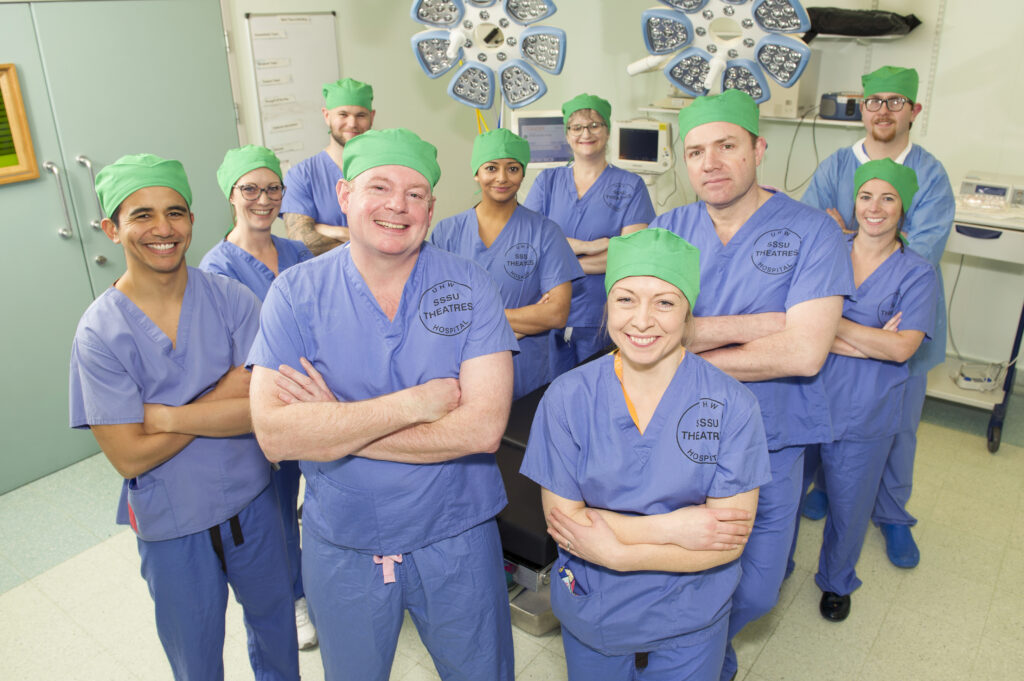
I had the pleasure of catching up with the ophthalmic surgeon, Dan Morris, over the lunch break last week. Dan is a leading voice in sustainable healthcare and a founding member of the RCOphth Sustainability Working Group. We are fortunate to have him as a colleague here in Cardiff and Vale where he works as an orbital surgeon with the skull base team as well as being the match ophthalmologist for the Welsh Rugby Union. Dan is well regarded for his avuncular approach towards his peers, not least to his juniors, and medical undergraduates, for whom he has become a source of knowledge and guidance as well as a supervisor of numerous sustainable healthcare projects. But underlying this calm and jovial exterior, is a genius (in the classic sense), which seems to have guided Dan through a variety of challenging pursuits each of which has deepened his resolve to care for the planet.
When he was fourteen, he persuaded his teachers to introduce a paper recycling skip into their school. Not long after this, he became one of the junior members of Greenpeace, which did more than any other group in the 1990s to raise public awareness of the effect of CFCs, ozone depletion, and global warming. Whilst growing up in Shropshire, he developed a taste for mountaineering and climbing in North Wales, earning his stripes on the classic routes in the Llanberis pass. A serious fall on sea cliffs as a student at St Andrews did nothing to dent his enthusiam for mountaineering, which has taken him to some of the most beautiful places on earth and into the world of field research & expedition medicine, which he now teaches to the next generation of young doctors.
There are, however, glaciers on which Dan has climbed, which have long since receded, and some have even vanished. Seeing the direct consequences of climate change in places that many of us will never visit, has motivated Dan to place sustainability at the heart of his work as a surgeon. This motivation is compounded by a desire that his children and those of the next generation will inherit a planet where they can still encounter the experiences of natural beauty that have sustained Dan.
The NHS, which makes up about 30% of the public sector in the UK, remains responsible for about 5% of all greenhouse gas emissions. Dan believes that healthcare professionals should be leading the way when it comes to reducing the harm caused by climate change. For his work, with the Sustainable Surgery in Wales Team, he was short-listed for the 2020 BMJ Awards. This includes research that highlighted the high carbon footprint of cataract surgery in the UK compared to other lower-resource settings.
One of these is the Aravind Eye Care System in Southern India, which has developed high-quality, low-cost services with a reduced carbon footprint. Ninety of their operations are equivalent to two of ours in terms of their carbon footprint, which they achieve partially by reusing equipment, but also through assembling as many four patients in each operating theatre at one time.
Despite differing approaches to factors such as infection control, risk, litigation etc, there are ways in which we can further decarbonise our own cataract procedures. For example, hospital-based post-op care can be withdrawn with the knowledge that patients are well-cared for by their routine follow-up appointments with their optician; single-used plastic gowns can be replaced with washable linen alternatives; we can accommodate ten to twelve patients rather than six to eight patients on cataract lists.
Cataract surgery is the single most common operation performed in the UK. In research that is now almost a decade old, Dan demonstrated that one cataract surgery had a carbon footprint of 181.1 kg carbon dioxide equivalent (CO2 eq) and that the 2230 procedures in this study had a total carbon footprint of 405.4 tons of CO2 eq. When one considers that the average carbon footprint for one U.K. resident per year is generally estimated at 10 tons of CO2 eq, this represents a significant carbon load. Of this, a great deal can be accounted for by waste disposal and travel, but 54% comes down to procurement.
Surgeons based in Cardiff and Vale UHB introduced a novel quality improvement tool (the Eyefficiency App) to five different hospitals in Wales. This facilitates real-time analysis of both productivity and carbon footprint of a cataract operating list, and allows us to audit, measure carbon emissions, encourage best practice but also help raise awareness of resource management. The involved a collaboration that included patients, surgeons, anaesthetists, ward nurses, theatre staff, estates managers, theatre managers and in the community both GP’s and optometrists. Using the app, they showed a 33% reduction in carbon emissions from cataract surgery using simple measures such as reducing visits to hospital, using energy efficient lighting, reducing waste and working with industry to improve the supply chain and minimise packaging.
Dan thinks that we have reached a real moment of inflection: “The goals of post-Covid recovery and sustainable healthcare have converged. As we rethink our clinical pathways and bureaucratic processes, this convergence requires us to reset our system in ways that are leaner and greener for the sake of better patient care now and for future generations.”
The importance of ‘green recovery’ has been acknowledged with funding of £100m from Welsh Government to reduce health inequalities; strengthen primary and community care; improve digitization; support the workforce; create supportive mental health services and better coordination between health and social services. The real wins are going to come from procurement and industry and from taking a localised approach in which each clinical board is supported to develop their own sustainability plan.
Although the demands of green recovery might seem overwhelming, there are examples in our own health board of the progress that can be made (see previous blogs) and there are leaders in this rapidly emerging field to guide the way, such as Anthony Costello, Muir Gray, and David Pencheon. If we can find ways to support our own leaders like Dan and nurture the next generation of sustainable healthcare leaders, then the opportunities to redesign our clinical services and contribute to one of the great challenges of our age might provide the pride and purpose that so many of us looking for in our work.
There is a classic route on Dinas Cromlech in the Llanberis pass called Noah’s Warning (“Follow the striking crack to a crozzly area of rock and trend slightly right up past bulges. Turn a final tricky overlap on the left to reach a ledge. Follow the wide crack above to a steep flake. Move right into a faint scoop, turn the bulge on the right to enter a think crack to a ledge and belay.”) To climb such a route requires sustained training, careful preparation and a willingness to expose oneself to failure and risk. These virtues, first rehearsed all those years ago, have no doubt sustained Dan in his work this far and serve now as an invitation to us all to follow – if not literally in his footsteps – then certainly his lead, and to embed the principles of sustainable healthcare in whatever territory we find ourselves.